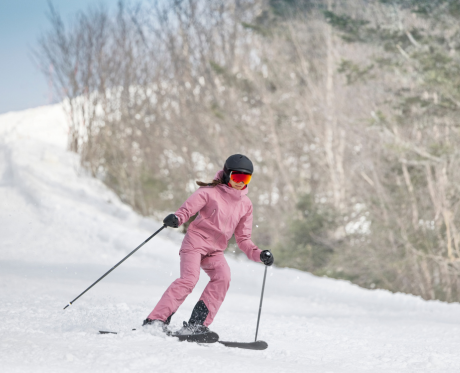
Winter has arrived and there is snow on the mountains which means many of you are going to be grabbing your gear and hitting the slopes. Skiing is a whole body activity that requires a considerable amount of leg and core strength, balance, and neuromuscular control to stay upright through turns and on uneven ground. It is important to perform strengthening exercises to address the specific needs of skiing in order to get the most out of your runs and decrease your risk of sustaining an injury on the mountain.
Be strong on one leg!
Single leg strength is key to help maintain control during turns and to ensure side to side symmetry. Pick from any of the exercises below and really focus on moving slowly through the lowering phase as this stresses your muscles eccentrically (strengthening while lengthening) which is also important for skiing. Perform 2-4 sets of 8-12 repetitions depending on how difficult the move is for you. Add resistance from dumbbells to increase the challenge.
Jump around!
If you feel really strong with all of those exercises you can progress to plyometrics (jumping drills). Jump squats and jumping lunges are both excellent options for increasing power and strength in you legs. Work up towards 3 rounds of 30 seconds of jumps. Make sure you are still keeping an eye on your knees, keep them pointing straight forward, not caving in towards each other.
Balance is key!
Balance is also extremely important due to the slippery and unstable surface or snow. Adding balance exercises into your workouts will help improve motor planning and control in these unstable circumstances. If you have access to a Bosu, this is an excellent tool for adding instability to your exercises. Practice standing on one foot on the Bosu and see if you can work up to 1 minute of balancing. You can also practice squatting on the flat side of the Bosu. If you don’t have access to that equipment you can try standing on one leg with your eyes closed and see if you can work up to holding for a minute without losing your balance!
Stretch it out!
Lastly, spend some time stretching your quads, hamstrings, and calves as depicted below to make sure you have enough range of motion to get into a good skiing position. It’s a good idea to hold the stretches for at least 30 seconds and perform 3 rounds.
Reference:
Hydren, JR. Volek JS. Maresh CM. Comstock BA. Kraemer WJ. Review of Strength and Conditioning for Alpine Ski Racing. Strength & Conditioning Journal. 35(1) 10-28. Feb 2013.